How does proMGE work
Step 1: Recombinase detection
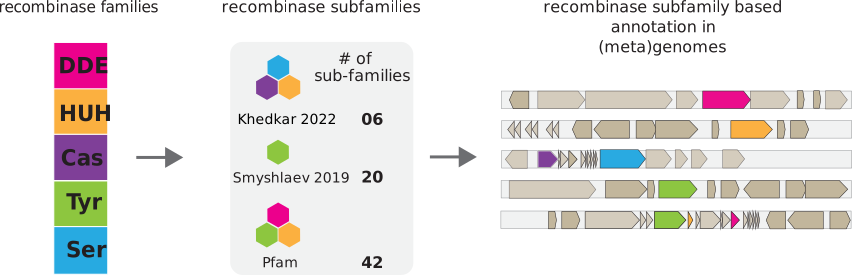
MGE recombinases are detected via profile HMM searches against our MGE-specific recombinase models on the called and translated genes of an input genome.
MGE recombinases
Step 2: Pangenome estimation

Pangenome estimation was performed in two steps. First, core and accessory gene sets were identified by clustering all genes within each species cluster and classifying genes based on predefined core genome thresholds (95% presence across isolate genomes and 80% across MAGs). Second, genomic islands were identified by scanning genes along each contig in genomic order. A new island was initiated whenever the gene type (core or accessory) differed from that of the current island, a contig boundary or when no island had yet been defined. Only genomic islands containing at least one mobile genetic element (MGE)-associated recombinase were retained for downstream analyses.
Step 3: Rule-based MGE category assignment

MGE categories were assigned as follows. Recombinase subfamilies uniquely associated with a single MGE type were assigned directly, while phage structural genes and conjugation machinery genes were used to further resolve phage versus phage-like elements and conjugative elements versus mobility islands, respectively. For recombinase subfamilies shared across multiple MGE types, MGE assignment was resolved using a rule-based approach that integrated the recombinase subfamily–MGE associations with the presence or absence of phage structural genes and/or conjugation machinery genes, as relevant.
Explore biological insights
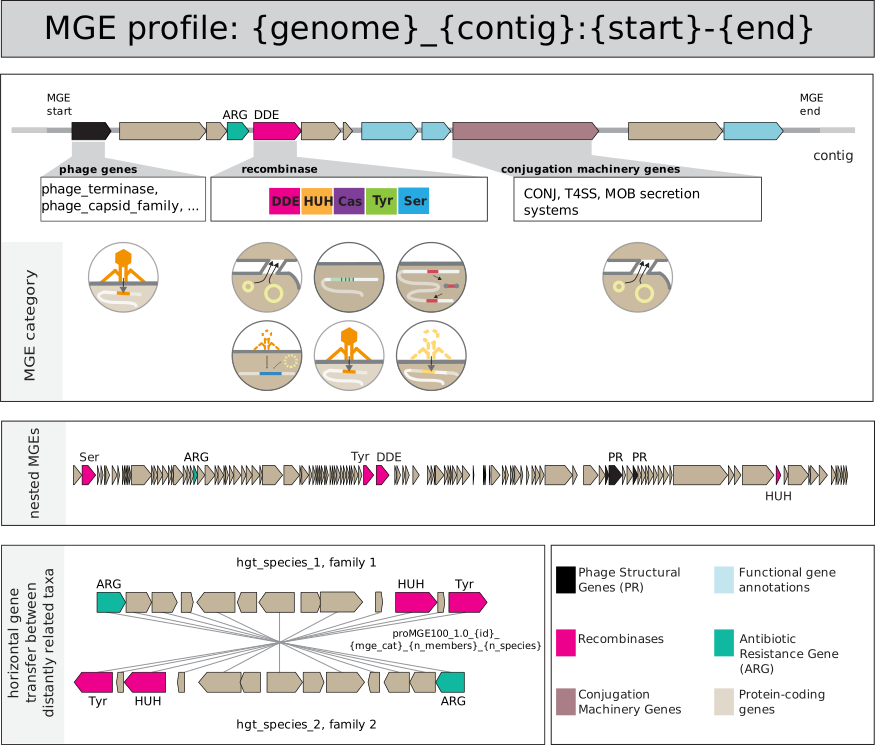
Explore mobile genetic elements (MGEs) across thousands of microbial species from isolate genomes and metagenome-assembled genomes (MAGs). Investigate their diversity, distribution, and host range by browsing MGE categories and the representative MGE100 clusters (100% ANI clusters).
Identify widely disseminated MGEs by filtering for representative MGE100 clusters or for putative horizontal gene transfer (HGT) links, defined as identical (100% ANI) MGE sequences detected in genomes belonging to different taxonomic families. Explore species pairs connected by shared MGEs and the taxonomic breadth of each MGE100 cluster.
Examine the functional potential of MGE cargo genes through annotations including antibiotic resistance genes from the Comprehensive Antibiotic Resistance Database (CARD), Clusters of Orthologous Genes (COGs), recombinases, secretion systems, phage-associated genes, and other functional markers. Visualize the gene content of each MGE together with its genomic context using the interactive MGE Viewer integrated to the SPIRE resource.
A complete list of COG categories including functional description is available for download from the EggNOG v5 website.
Export customized search results or download the complete proMGE dataset from the Download page.
MGE visualisation
All MGEs from a species clusters (specI) were grouped and mapped to a representative isolate genome or MAG depending on the source of MGEs. For mixed MGE origins (both isolate and MAG), MGEs were mapped to a representative isolate genome. A custom script was used for alignment and visualisation.
References
- Alcock, B. P., Huynh, W., Chalil, R., Smith, K. W., Raphenya, A. R., Wlodarski, M. A., Edalatmand, A., Petkau, A., Syed, S. A., Tsang, K. K., Baker, S. J. C., Dave, M., McCarthy, M. C., Mukiri, K. M., Nasir, J. A., Golbon, B., Imtiaz, H., Jiang, X., Kaur, K., … McArthur, A. G. (2023). CARD 2023: Expanded curation, support for machine learning, and resistome prediction at the Comprehensive Antibiotic Resistance Database. Nucleic Acids Research, 51(D1), D690–D699. https://doi.org/10.1093/nar/gkac920
- Bonin, N., Doster, E., Worley, H., Pinnell, L. J., Bravo, J. E., Ferm, P., Marini, S., Prosperi, M., Noyes, N., Morley, P. S., & Boucher, C. (2023). MEGARes and AMR++, v3.0: An updated comprehensive database of antimicrobial resistance determinants and an improved software pipeline for classification using high-throughput sequencing. Nucleic Acids Research, 51(D1), D744–D752. https://doi.org/10.1093/nar/gkac1047
- Cantalapiedra, C. P., Hernández-Plaza, A., Letunic, I., Bork, P., & Huerta-Cepas, J. (2021). eggNOG-mapper v2: Functional Annotation, Orthology Assignments, and Domain Prediction at the Metagenomic Scale. Molecular Biology and Evolution, 38(12), 5825–5829. https://doi.org/10.1093/molbev/msab293
- Fullam, A., Letunic, I., Schmidt, T. S. B., Ducarmon, Q. R., Karcher, N., Khedkar, S., Kuhn, M., Larralde, M., Maistrenko, O. M., Malfertheiner, L., Milanese, A., Rodrigues, J. F. M., Sanchis-López, C., Schudoma, C., Szklarczyk, D., Sunagawa, S., Zeller, G., Huerta-Cepas, J., von Mering, C., … Mende, D. R. (2023). proGenomes3: Approaching one million accurately and consistently annotated high-quality prokaryotic genomes. Nucleic Acids Research, 51(D1), D760–D766. https://doi.org/10.1093/nar/gkac1078
- Khedkar, S., Smyshlyaev, G., Letunic, I., Maistrenko, O. M., Coelho, L. P., Orakov, A., Forslund, S. K., Hildebrand, F., Luetge, M., Schmidt, T. S. B., Barabas, O., & Bork, P. (2022). Landscape of mobile genetic elements and their antibiotic resistance cargo in prokaryotic genomes. Nucleic Acids Research, 50(6), 3155–3168. https://doi.org/10.1093/nar/gkac163
- Kim, C. Y., Podlesny, D., Schiller, J., Khedkar, S., Fullam, A., Orakov, A., Schudoma, C., Robbani, S. M., Grekova, A., Kuhn, M., & Bork, P. (2026). Planetary microbiome structure and generalist-driven gene flow across disparate habitats. Cell, 189(7), 2073-2091.e21. https://doi.org/10.1016/j.cell.2025.12.051
- Letunic, I., & Bork, P. (2026). SMART v10: Three decades of the protein domain annotation resource. Nucleic Acids Research, 54(D1), D499–D503. https://doi.org/10.1093/nar/gkaf1023
- Mende, D. R., Sunagawa, S., Zeller, G., & Bork, P. (2013). Accurate and universal delineation of prokaryotic species. Nature Methods, 10(9), 881–884. https://doi.org/10.1038/nmeth.2575
- Néron, B., Denise, R., Coluzzi, C., Touchon, M., Rocha, E. P. C., & Abby, S. S. (2023). MacSyFinder v2: Improved modelling and search engine to identify molecular systems in genomes. Peer Community Journal, 3. https://doi.org/10.24072/pcjournal.250
- Néron, B., Littner, E., Haudiquet, M., Perrin, A., Cury, J., & Rocha, E. P. C. (2022). IntegronFinder 2.0: Identification and Analysis of Integrons across Bacteria, with a Focus on Antibiotic Resistance in Klebsiella. Microorganisms, 10(4), Article 4. https://doi.org/10.3390/microorganisms10040700
- Schmidt, T. S. B., Fullam, A., Ferretti, P., Orakov, A., Maistrenko, O. M., Ruscheweyh, H.-J., Letunic, I., Duan, Y., Van Rossum, T., Sunagawa, S., Mende, D. R., Finn, R. D., Kuhn, M., Pedro Coelho, L., & Bork, P. (2024). SPIRE: A Searchable, Planetary-scale mIcrobiome REsource. Nucleic Acids Research, 52(D1), D777–D783. https://doi.org/10.1093/nar/gkad943
- Smyshlyaev, G., Bateman, A., & Barabas, O. (2021). Sequence analysis of tyrosine recombinases allows annotation of mobile genetic elements in prokaryotic genomes. Molecular Systems Biology, 17(5), MSB20209880. https://doi.org/10.15252/msb.20209880
- Ugarcina Perovic, S., Ramji, V., Chong, H., Duan, Y., Maguire, F., & Coelho, L. P. (2025). argNorm: Normalization of antibiotic resistance gene annotations to the Antibiotic Resistance Ontology (ARO). Bioinformatics, 41(5), btaf173. https://doi.org/10.1093/bioinformatics/btaf173